


At the 2026 New York International Auto Show (NYIAS), Hyundai surprised us by unveiling the Boulder Concept, a rugged design study that serves as a “design preview” for the brand’s first-ever fully boxed body-on-frame architecture. While the show floor was filled with talk of its “Art of Steel” aesthetic and 37-inch mud-terrain tires, the technical backbone of this platform is rooted in a significant new U.S. patent that details how Hyundai plans to integrate heavy-duty EV performance into a traditional ladder-frame chassis. This patented architecture will underpin a production midsize pickup truck slated for the North American market by 2030.
The “Boulder” Patent: A New Approach to Chassis Design
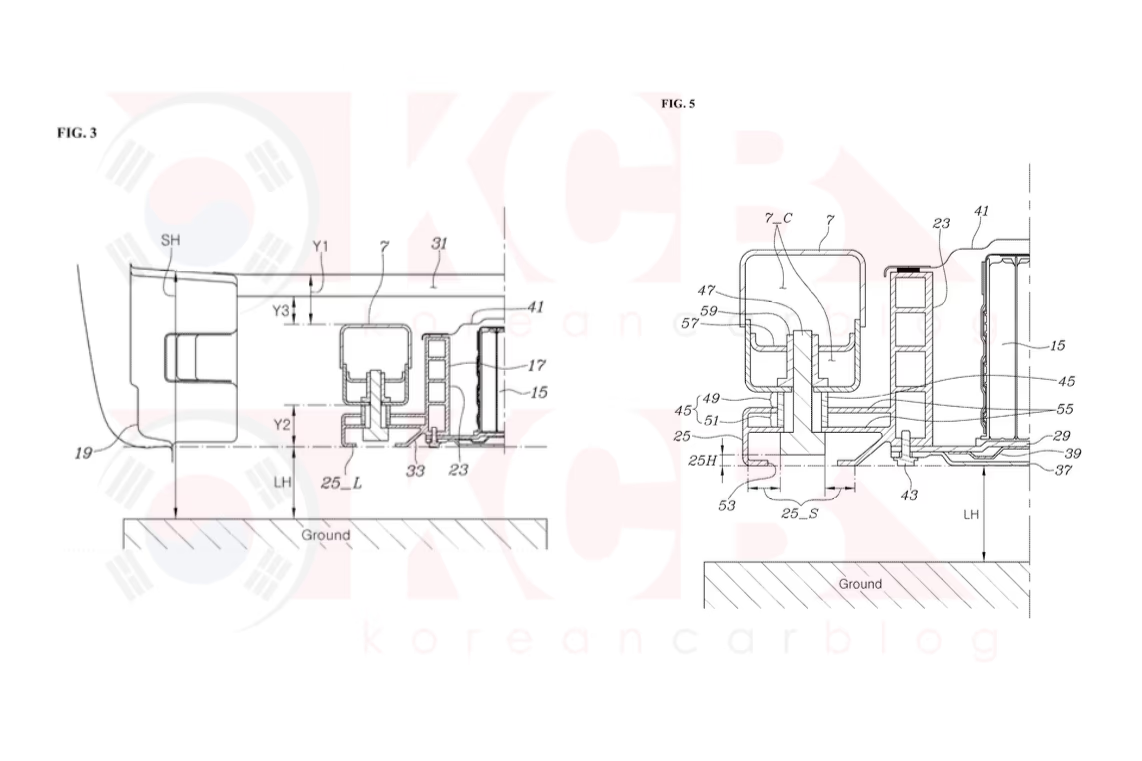
The U.S. patent, titled “Battery Pack Mounting Structure for Vehicle,” outlines a specialized ladder-frame construction that differs from the unibody platforms found in every other current U.S. Hyundai model.
Horizontal Battery Integration: The patent describes a battery pack disposed to “overlap inwardly” from the frame side members in a horizontal direction. This design allows the battery to sit low within the frame rails, lowering the center of gravity while protecting the cells with high-strength steel.
Impact Defense System: To meet the safety requirements of a heavy-duty pickup, the chassis includes a “vehicle body side chamber” outside the frame member. This chamber forms a deformation section—set to 5% to 20% of the vehicle’s overall width—specifically engineered to absorb side-impact forces before they reach the battery case.
Structural Bulkheads: The battery case side units feature a vertical cross-section with multiple internal “closed spaces” or bulkheads. These are aligned on the same horizontal plane as the frame reinforcement panels to effectively suppress deformation during a collision.
Ground Height Optimization: The “L-shaped” cross-section of the case side units allows the lower end portion to align with the lowest ground height (LH) of the vehicle. This ensures maximum ground clearance for off-roading while minimizing the step height required for passengers to board the vehicle.
Designed, Developed, and Built in America
Hyundai’s strategy for this pickup is uniquely focused on the United States, representing a major shift in the company’s manufacturing philosophy.
U.S. Steel Sourcing: The production vehicle will be built using steel from a new $5.8 billion plant in Louisiana, emphasizing the “Art of Steel” philosophy that views the raw metal as a design element itself.
Local Production: The 2030 pickup will be manufactured in America, likely at or near the $12.6 billion Georgia Metaplant.
Powertrain Flexibility: While the patents focus on battery integration, the ladder-frame architecture is designed to be powertrain-agnostic, supporting electric, combustion, and hybrid layouts to meet various regional needs.
Beyond the Pickup: A Body-on-Frame Lineup
While the midsize pickup arrives first by 2030, the Boulder Concept’s SUV shape suggests that a rugged SUV variant—potentially rivaling the Ford Bronco or Jeep Wrangler—is also under consideration for this platform. The patent specifically notes that this mounting structure provides the “unlimited potential for rugged off-road capability” required for such a lineup.
The Bottom Line
By securing the U.S. patent, Hyundai has laid the technical groundwork for a pickup that matches the durability of traditional trucks with the safety and efficiency of modern EVs. The 2030 pickup won’t just look like a truck; it is engineered from the frame up to be the “backbone of American work and adventure”.


Comments
No comments yet. Be the first.