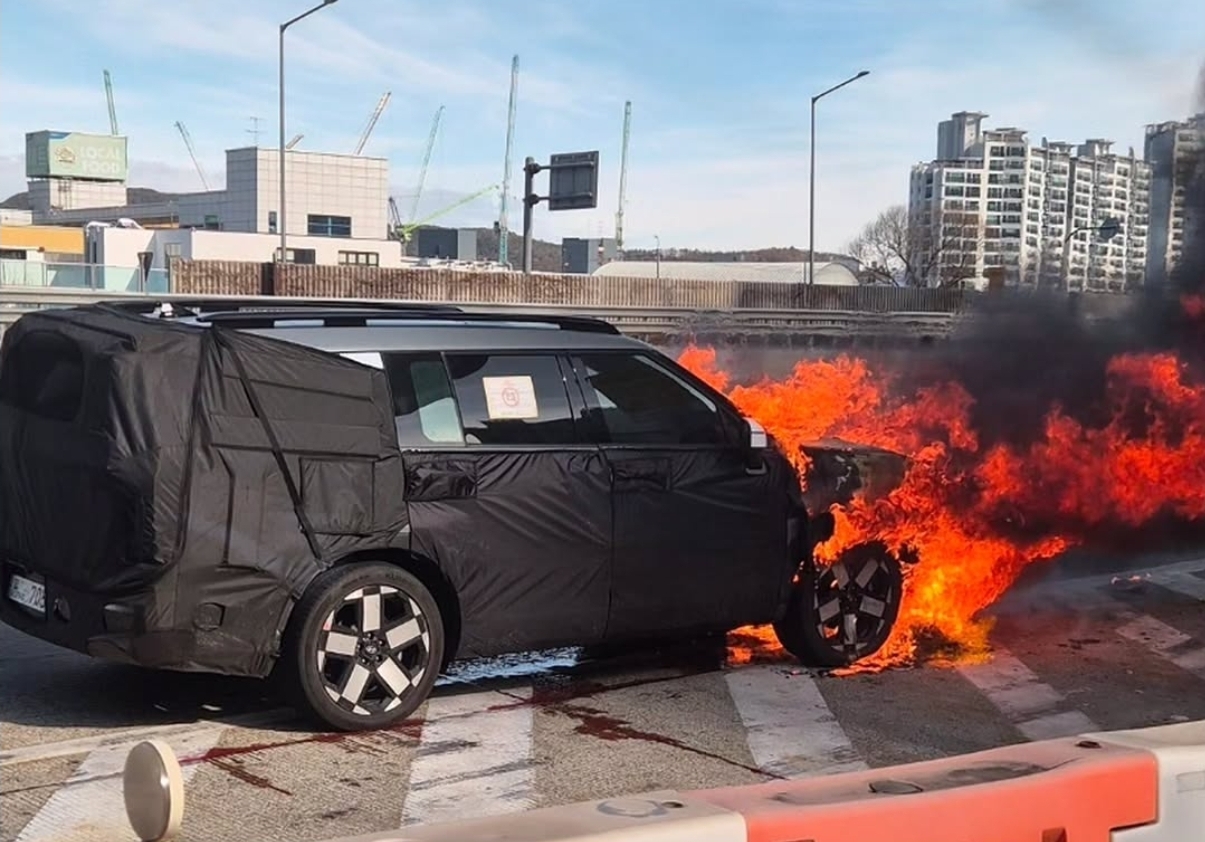
A Hyundai Santa Fe development test vehicle caught fire in South Korea shortly after departing Hyundai Motor Company’s Ulsan manufacturing complex, per Naver report, leading to a formal investigation by the automaker. While the incident has drawn attention to Hyundai’s future electrification strategy, the powertrain type involved remains unconfirmed, and no link to Hyundai’s EREV (Extended-Range Electric Vehicle) technology has been established.
Incident Occurred During Post-Factory Test Driving
The vehicle was reportedly a pre-production export model that had just left the Ulsan plant for a routine validation drive. The fire occurred near the Ulsan Expressway tollgate in Ulju County, and although the vehicle was completely destroyed, the driver evacuated safely and no injuries were reported.
Hyundai has confirmed that the vehicle was in the development testing phase, emphasizing that such testing is a normal part of ensuring quality and safety before mass production.
Powertrain Specification Remains Unknown
At present, Hyundai has not disclosed whether the test vehicle was a hybrid, internal combustion, or equipped with new electrified technology. While speculation has emerged that the export designation could indicate an EREV configuration, industry observers caution that this remains purely speculative.
Hyundai’s EREV system is still under development and is expected to undergo extensive validation across multiple regions and vehicle platforms, meaning multiple powertrain variants may currently be in testing simultaneously.
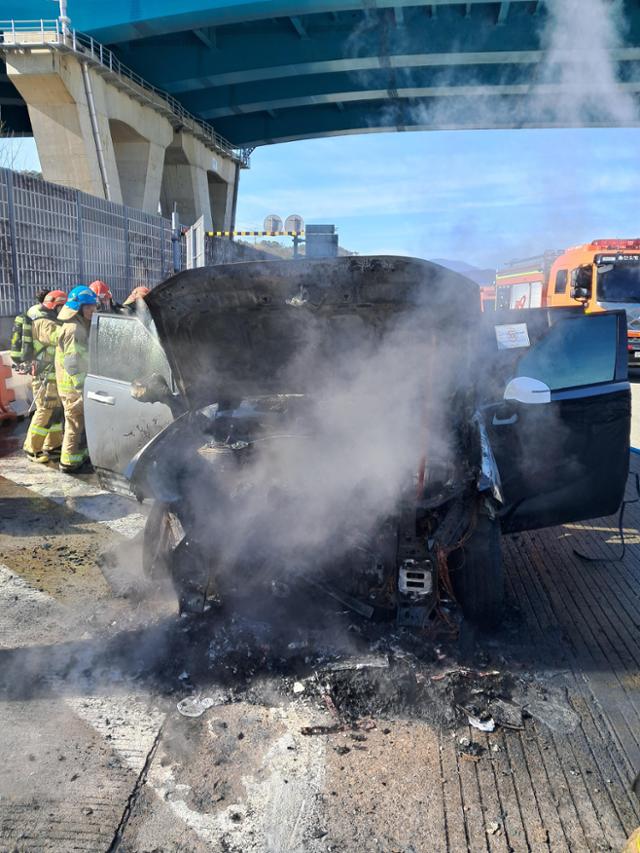
Photo courtesy of Naver
Why Caution Is Warranted in Linking the Fire to EREV
Experts stress that isolated development-stage incidents should not be interpreted as evidence of systemic issues, particularly when:
- The exact fire origin has not been identified
- The vehicle’s powertrain and energy system remain unconfirmed
- Early-stage test vehicles often include temporary wiring, sensors, and experimental components
- Fires can originate from non-electrified systems, including fuel lines, oil leaks, or auxiliary electronics
Until Hyundai completes its investigation, attributing the incident to any specific technology would be premature.
Potential Impact on EREV Timelines Likely Limited
Even if the vehicle were eventually identified as an EREV prototype, a single test-vehicle incident does not automatically imply delays. Development programs typically include redundancy testing, alternative prototypes, and parallel validation paths, allowing schedules to remain largely intact unless a fundamental design issue is discovered.
In many cases, such incidents result in localized corrective actions rather than broad program setbacks.
Hyundai Focused on Root-Cause Analysis
Hyundai Motor Company has stated that it will retrieve the vehicle and conduct a detailed forensic investigation. The automaker has not announced any changes to its Santa Fe product roadmap or electrification strategy, and no recalls or production halts have been indicated.
Conclusion: Investigation Ongoing, Conclusions Premature
The Hyundai Santa Fe test vehicle fire is currently best viewed as a development-stage incident under investigation, not as an indicator of problems with Hyundai’s EREV technology or hybrid systems.
Until official findings are released, industry observers are advised to separate confirmed facts from speculation and allow the investigation process to run its course. market, particularly as manufacturers balance innovation, safety, and global launch timelines.