


Hyundai Motor Group is taking aggressive steps to restore consumer confidence in the European electric vehicle market. Following reports of persistent issues with Integrated Charging Control Units (ICCUs), the automotive giant has announced a significant warranty extension in Germany, signaling a potential rollout across the continent.
The New 15-Year Warranty: Coverage Details
The German sales divisions of both Hyundai and Kia have committed to addressing ICCU defects free of charge for an unprecedented duration. This move follows a similar measure recently implemented in Finland.
| Feature | German Warranty Terms | Korean Warranty Terms (Comparison) |
|---|---|---|
| Duration | 15 Years | 15 Years |
| Mileage Limit | 300,000 km | 400,000 km |
| Eligibility | Initial registration date | Initial registration date |
This 15-year commitment essentially covers the entire life cycle of the vehicle, far exceeding the industry standard of 8 to 10 years for core EV components.
Affected Models and Production Dates
The warranty extension specifically targets vehicles built on the E-GMP platform before recent design improvements were integrated.
Hyundai Models
- IONIQ 5: Produced before April 2024.
- IONIQ 6: Produced before September 2024.
- Note: Later models already feature an improved ICCU design.
Kia Models
- EV6 (including EV6 GT): Pre-facelift models produced before June 15, 2024.
Genesis (South Korean Market Context)
In the domestic Korean market, the expansion also covers luxury electrification models including the GV60, GV70, and G80.
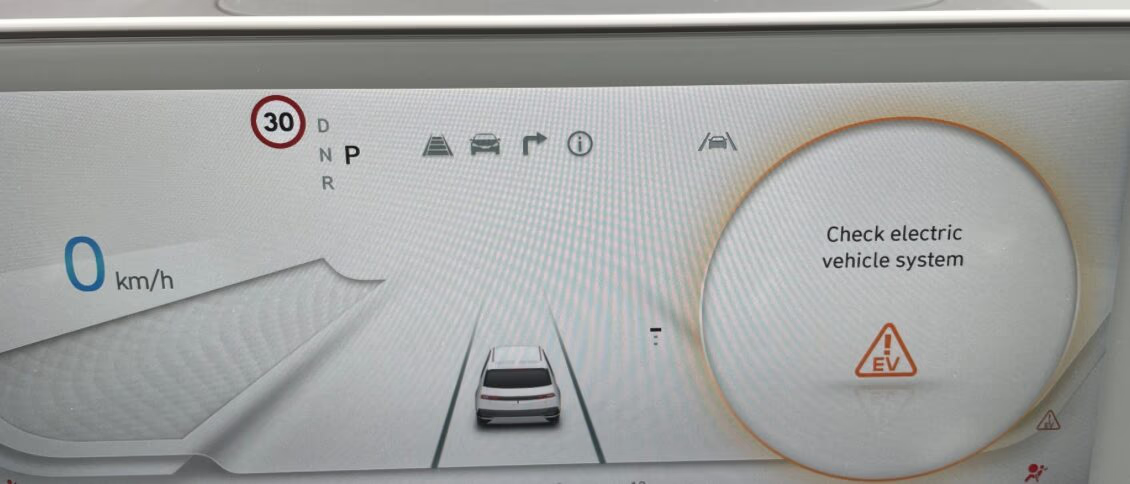
Understanding the ICCU Defect
The Integrated Charging Control Unit (ICCU) is a critical component for E-GMP vehicles. It manages:
- Onboard Charging: Handling 11 kW AC charging.
- V2L (Vehicle-to-Load): Powering external electronic devices.
The Problem: Durability and Safety
The “chronic defect” cited by consumers involves sudden hardware failure without warning. When an ICCU fails:
- The vehicle stops charging entirely.
- Towing is often the only solution.
- Replacement parts have previously taken weeks to arrive.
Prior to this warranty expansion, an out-of-warranty ICCU repair could cost owners approximately 2.2 million won (approx. €1,500). By extending the warranty, Hyundai and Kia are shifting the financial risk from the consumer back to the manufacturer.
Industry Reaction: A Model for Other Automakers?
German EV expert Stefan Möller praised the move, stating, “This is a very impressive move and other automakers deserve to learn from it.” By taking responsibility for a known quality issue, Hyundai and Kia are attempting to stabilize resale values and brand loyalty.
Is a Warranty Extension Enough?
Despite the positive reception, some critics and owners remain skeptical. The primary concern is that the current fix relies on software updates and after-sales support rather than a universal hardware replacement for all affected units.
“It remains to be seen whether the defect itself is completely eliminated.”
Kia Germany has acknowledged that “recurrence was confirmed in some replacement parts,” fueling arguments that a software recall may not be a fundamental solution to a hardware durability issue.
Conclusion
For current IONIQ 5, IONIQ 6, and EV6 owners in Europe, this 15-year warranty provides significant peace of mind regarding repair costs. However, the pressure remains on Hyundai Motor Group to prove that their “improved design” and software patches can permanently resolve the ICCU failure rate.
News source: Hyundai DE and KIA DE


Comments
No comments yet. Be the first.